
Australia's peak industry body for Sports Turf Management
Australia's peak industry body for Sports Turf Management
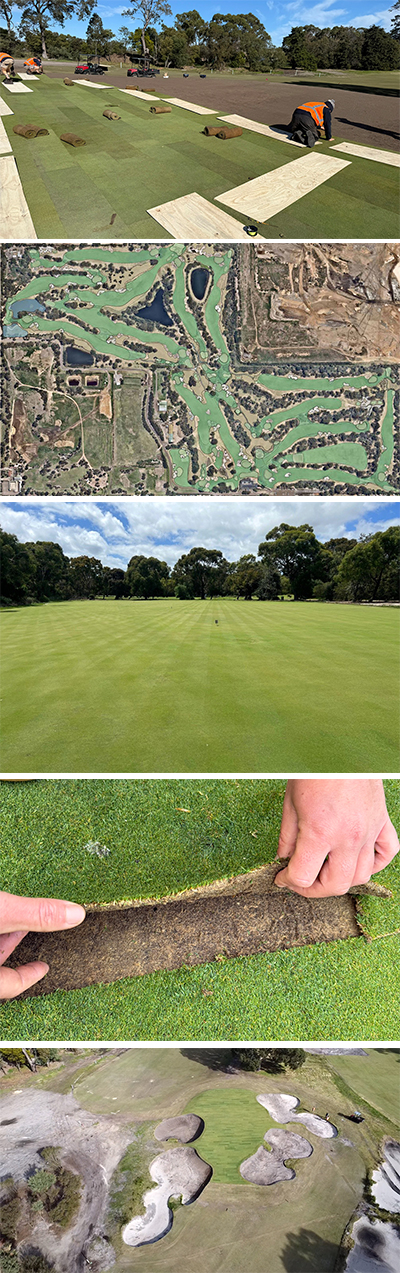 Spring Valley Golf Club in Melbourne is nearing the end of the first phase of its major course masterplan works under the auspices of OCM Golf. Since the start of July, the Melbourne Sandbelt club has embarked on a staged greens replacement program, with the first four greens – 10, 11, 18 and the practice putting green – all reconstructed and being grassed with Oakley bentgrass. While some clubs around the country have been interseeding their greens with Oakley, the Melbourne Sandbelt club is among the first in Australia to fully convert to the new variety, joining Yowani CC in Canberra which is also undergoing a major course redevelopment.
Spring Valley joins a slew of Melbourne’s premier Sandbelt courses which have recently undergone or are currently undergoing major redevelopments. They include the likes of Victoria, Yarra Yarra, Commonwealth, Metropolitan and Huntingdale, the latter of which has been a complete redevelopment. Three key drivers are behind the current Spring Valley works;
With the club wanting to explore all options regarding grass selection, Anthony undertook extensive research. After analysing the National Turfgrass Evaluation Program (NTEP) trials in the US, along with Dr Jim Baird’s trials at the University of California, the decision was made for Anthony to travel to the US to see the varieties in a climate similar to Melbourne. He visited trial sites in California, Nevada (Shadow Creek GC), Utah and Oregon, along with courses that had recently undertook similar greens replacement programs. Following those visits and inspections, Anthony made the recommendation to the Spring Valley Board to proceed with Oakley.
“We decided to go with Oakley for a number of reasons,” says Anthony, who has been Spring Valley superintendent since late 2021. “It has good drought and disease tolerance, has an upright growth habit and has the ability to withstand very low inputs of nitrogen while maintaining adequate density with the 60,000-plus rounds a year and shaded greens we have. The opinion was that most of the new generation bents are good, although organic matter accumulation could be a problem if not managed accordingly. To combat this the club has agreed, every 8-12 years, to mechanically remove all the organic matter and reuse the existing turf if free of Poa annua.”
After the club gave Anthony the green light to proceed with Oakley, the Spring Valley crew established a 5500m2 bentgrass nursery (pictured above) to be used throughout the project, with the idea to solid turf greens when appropriate to lessen the disruption to members. The first stage of works began in early July, shortly after Anthony’s return from volunteering at the 125th US Open at Oakmont Country Club. All greens had the organic matter and sand profile removed to a depth of 450mm. Grey dune sand, mined from the greens, has been kept for future green and bunker construction.
“The sand used is being blended onsite and is a mix of the native grey dune sand and imported sand from Burdetts to ensure optimum firmness is maintained,” explains Anthony. “The blended greens sand profile is 450mm, with at least 600mm depth of native sand underneath that. The aim is to have all greens built out of at least one metre of sand.”
Fumigation of the sand was undertaken onsite by Draslovka to ensure no weed and nematode issues. Turfing was completed 17 days after fumigation, although could have been undertaken after 10 days. Anthony says a conservative approach was taken due to the moisture in the sand profile at the time of fumigating. Greens were then turfed with a high priority being to harvest the turf as thin as possible (sod depth approx. 5mm, pictured below) to minimise the amount of organic matter in the new greens.
As part of the greens works, subsurface drainage has been added and all greens have been re-contoured to ensure adequate surface runoff and more pin locations where possible. As well as the greens, all greenside bunkers have had some form of work completed, whether that has been repositioning, improving access points or reshaping them to look more like Morcom’s original design.
With turfing works on 10 (pictured below) and 11 completed, over the next couple of weeks Anthony and his team will complete the 18th and practice green, with the aim of having all turfing done by mid-September and holes reopened the first week of November. Stage 2 of the masterplan works will kick off next July and target holes 1, 2, 7-9 and 19, with the remainder to be completed in 2027.
Story: Brett Robinson with Craig Anthony; Photos: Craig Anthony/Spring Valley GC