
Australia's peak industry body for Sports Turf Management
Australia's peak industry body for Sports Turf Management
For the third consecutive year, The Grange Golf Club was the focus of the golfing world last week with LIV Golf Adelaide descending on the South Australian capital. The second event on the 2025 LIV Golf calendar, it took less than 30 minutes of play on Friday before the tournament was again creating worldwide headlines following Patrick Reed’s acing of the now famous Watering Hole with just the sixth tee shot of the day on the hole. Reed, who had teed off alongside his 4Aces teammates Harold Varner III and Thomas Pieters on the 11th and started with a bogey, recorded LIV Golf Adelaide’s second ace on the 151m par three 12th, following in the footsteps of Chase Koepka who achieved the feat midway through the final round back in 2023. 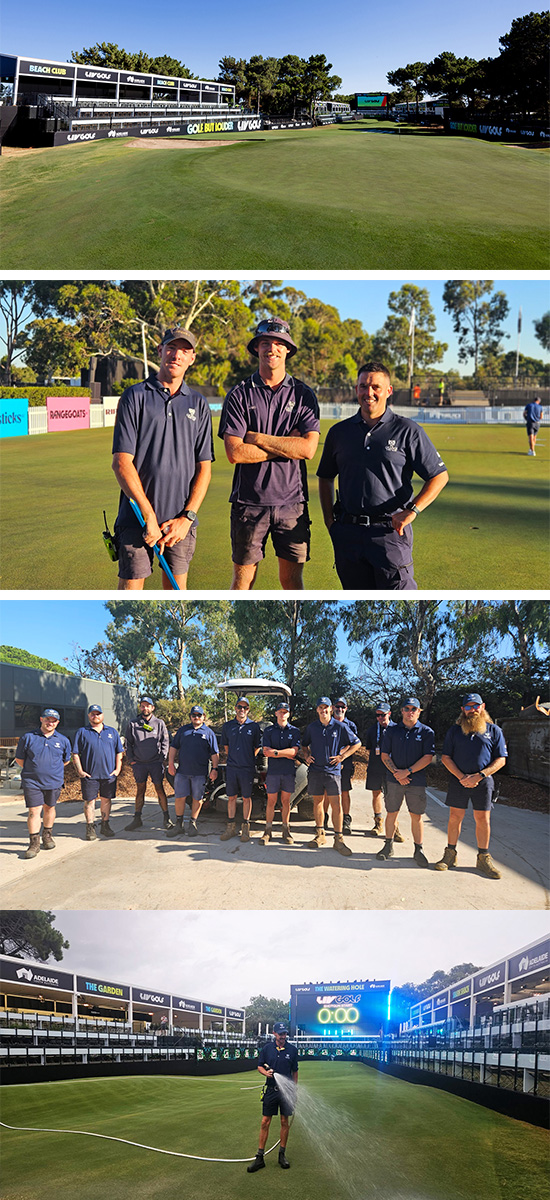
It was the perfect start to what was again a perfect week for course superintendent Rowan Daymond and his team, one which saw crowds in excess of 100,000 across the three tournament days. In a change from the past two years, the tournament was brought forward by more than two months following a schedule reshuffle. That thrust the tournament into the middle of an Adelaide summer and its prevailing hot and dry conditions which made for a few different challenges preparation-wise this time around.
Despite that, Daymond and his tournament crew – which numbered 56 for the week – again delivered a stage that had the players in awe, especially the hometown Ripper GC quartet of Cam Smith, Marc Leishman, Lucas Herbert and Matt Jones who headed into the week as defending teams champions after last year’s stunning playoff win. Herbert, fresh from pocketing $900,000 for finishing in a tie for fourth at the opening round at Riyadh Golf Club in Saudi Arabia, was effusive in his praise of the conditions at The Grange during the Ripper GC press conference held pre-tournament.
“I don’t think you can make The Grange Golf Club look any better than it does right now,” Herbert commented. “The greens are phenomenal. The fringes, the fairways, the rough, the tee boxes, just everything looks and plays phenomenally.” Ripper GC captain Cam Smith was quick to echo those sentiments: “We love the golf course. I think this is the best I’ve ever seen it. This place is in such good shape.”
As Daymond found with the past two iterations of LIV Golf Adelaide, it wasn’t the playing surfaces or the agronomics that provided the biggest challenge leading in to this year’s event. Again it was managing everything on the periphery with regards to the tournament build and logistics that required the most attention to detail.
In its first year 77,000 fans came through the turnstiles, with that number jumping significantly to 94,000 last autumn. This year more than 100,000 flocked to the 36-hole facility which meant a rethink with some of the activation zones, in particular the location of the main concert stage which featured the likes of popular Australian DJs Dom Dolla and Fisher. Around the course as well there were more grandstands and spectator viewing platforms than ever before, with an additional 3000-seated capacity for fans.
“The size of the event and the infrastructure footprint went up another level again,” explains Daymond. “Trying to manage the out of play and non-tournament areas in the kind of heat we had and with how dry it has was, combined with the amount of traffic and contractors moving around, had its moments. Irrigation in some areas had been off since before Christmas so things were starting to burn off a bit. We had to do a lot more handwatering on some of our couch areas as a result.
“The contractors were good again this year. We had iEDM back again who were fantastic last time. They were here at the start of December erecting scaffolding in the lead-up to Christmas. Once that had come and gone they were back in on 6 January and didn’t stop.
“As it has always been, it is usually the out of play type stuff that takes up a fair bit and I think we had nearly eight holes of the non-tournament course that were taken up with either infrastructure or parking. The activation zones took up another hole this year as we moved the concert stage to a different fairway to facilitate the numbers they were expecting (in excess of 20,000 each night). The stage was shifted across to the fairway on 3 West which gives them a good two hectares of space.”
Agronomically, Daymond wasn’t without a few challenges either. South Australia is known for being dry, but the past spring and summer were much drier than average. The Grange’s usual annual average rainfall is around 400mm but across 2024 received just 220mm. The course barely notched over 15mm of rain since the start of December and just 4mm since the start of January, with a couple of bursts of heat in the weeks leading up to the tournament also putting a premium on moisture management. Between 31 January and 7 February temperatures didn’t drop below 30 degrees, including two days of back-to-back 39s, while the Wednesday before round one saw a peak of 41.5. Despite those challenges Daymond was been pleased with how well the course held up.
“We got through that hot spell and thankfully temperatures backed off and we had mid-20s across the tournament days,” says Daymond. “Given what we had the last couple of weeks heat wise, the course was sitting in as good a place as it could be. The greens were a little bit on the slow side to start, but trying to keep fast and alive greens is not conducive in that sort of weather. We weren’t doing as much afternoon cutting as a result. We were only doing an afternoon cut on some of thosegreens that were a little bit slower and staying off the others. We were also handwatering more here and there but still irrigating at night depending on what our percentages were.”
While the timing of the tournament was different this time around, there were also a couple of other changes from a course perspective. Extra length, about 130 metres in total, was added to three holes by pushing the tournament tees back. Playing off the members black tees, LIV tournament hole 7 (East Course 16) went from a 470m to 513m par five, while tournament 8 (East Course 17) went from from a 325m to 365m par four. Tournament 2 (East Course 9) was played off the white tee, increasing the hole from 400m to 445m, and ended up playing as the hardest of the whole week.
The biggest change, however, came in terms of the agronomic support offered to Daymond and The Grange crew. Ahead of the new season kicking off, LIV Golf engaged the services of agronomists from The R&A to provide assistance to all host courses on the 2025 tournament rota. In November, Richard Windows and Daniel Lightfoot made a site visit and provided an initial report, with colleagues Pablo Munoz and Eugenio Rezola coming out in mid-January prior to heading to Riyadh for last week’s season opener. Windows, Munoz and Rezola were on site for tournament week and shadowed Daymond’s crew as they dialled in the course in.
“They were great,” says Daymond of The R&A trio. “They took our guys out with them each day to do their data collection, so it was good for the staff from an education perspective. They also did a presentation to the crew on the Wednesday on Open Championship set up. We’ve got a fantastic group of people on staff at the moment and Richard was very impressed with how engaged they were and how keen they were asking questions and learning as much as they can which is great to hear.
“The R&A guys were able to assist us with some advice on fertility practices which have been paying off really well. While we didn’t change what we do from a product perspective, we ramped up our fertility program a bit. We also had more of an emphasis on our wetting agent programs and the use of surfactants over penetrants.”
LIV Golf’s recent push to improve sustainability practices across its suite of tournaments also brought about another change this year. Having hand-mowed greens for the past two events, this year two Toro Greensmaster e-Triflex 3370 electric triplex mowers (pictured above, photo courtesy of Turf Management SA) were used to cut the A1 and A4 bentgrass/Poa greens across the composite course (the tournament layout is effectively made up of the back nines of the East and West courses).
While The Grange already had one of the 3370 units in their fleet, a second was shipped across a few weeks before the tournament, with turf technician Tom D’Arcy in regular contact with a fellow technician in Europe to assist with set up. Grange crew member Matthew Barnes headed up the two-person greens team with a volunteer on the other.
Toro was just one of a number of companies that again supported The Grange for the tournament, with Daymond also grateful for the support of Greenway Turf Solutions, Nuturf, Living Turf, WaterPro, Envu, K&B Adams and ASAP Coffee. A strong contingent of course volunteers, coordinated by The Grange’s course administration assistant Rebecca Bott, also descended for the week. A number returned from last year, while there was good representation from interstate as well.
The LIV tournament greens were cut at 2.8mm for the week, although the effective cut height was lower than that when looking through a prism gauge. The couch surrounds and approaches were cut at 8mm, tees 6mm and fairways 10mm. Dependent on speeds, greens were generally given a double cut with the triplexes in the morning. Afternoon cuts were dependent on speeds. Greens were rolled earlier in the week which got the speeds up to 12 or just over. The ASTMA congratulates Rowan, assistant Jeff Gillies and the entire tournament crew on their efforts.
Photos (from top down): The Watering Hole 12th at The Grange; The Grange course superintendent Rowan Daymond (right) with crew members Jayden Pearce (left) and Jared Charlton (centre); members of The Grange tournament crew numbered in excess of 50 for LIV Golf Adelaide; and handwatering couch areas on the Watering Hole.
Photos courtesy of LIV Golf Media and Marie Cunningham (Turf Management South Australia)