
Australia's peak industry body for Sports Turf Management
Australia's peak industry body for Sports Turf Management
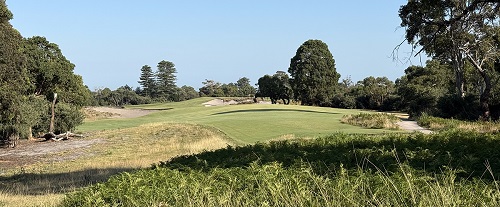 The Victorian Golf Course Superintendents Association (VGCSA) held its first meeting of 2025 with a visit to The National Golf Club’s Long Island course in Melbourne’s southeast last Tuesday. Hosted by The National’s golf course manager Leigh Yanner and Long Island superintendent Simon Page, the duo took more than 100 VGCSA members and industry representatives on a walk around the course which is three-quarters of the way through a major redevelopment. The meeting was sponsored by ADE Turf Equipment and Nuturf Equipment Solutions.
The Long Island project, which is being carried out under the auspices of OCM Golf, is one of the more fascinating golf course redevelopments in Australia at the moment. The most distinctive aspect of it is the flexible “course within a course” concept that OCM Golf has devised whereby they have drawn up three different 18-hole routings that can be played across the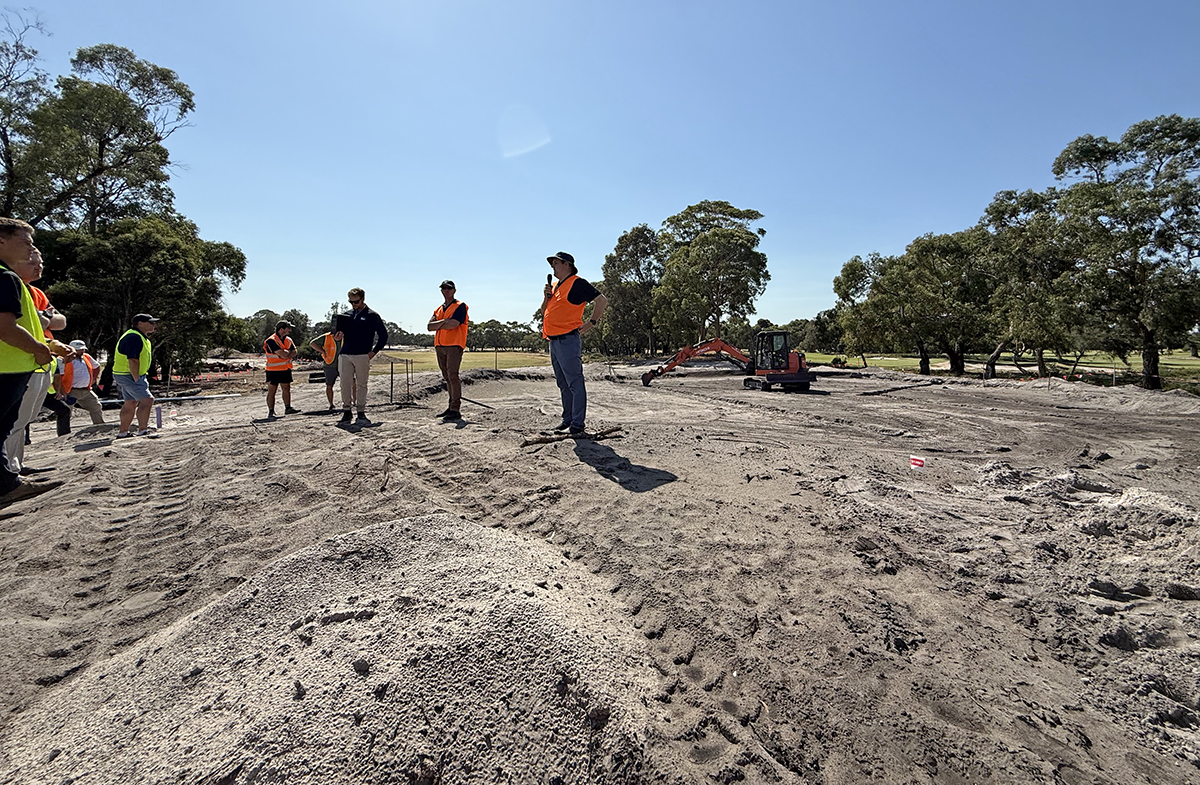 property.
This has entailed constructing a final layout that includes 20 greens and utilising the same greens and tees in varying combinations to create the three different routings. Golfers may encounter entirely different holes from one day or one week to the next based on which sequence of tees and pins are in play. In order to facilitate that, a large consideration with the greens design has been to build them so they can accept shots from different directions.
Following a comprehensive planning phase which involved many consultants, construction began at the Frankston-Dandenong Road site back in February last year. To date, 13 holes have been constructed with 10 greens down and a further two (3 and 13) to be seeded next Friday. With holes 17 and 18 recently taken out of play for works, members are currently playing a seven-hole routing which will hopefully return to nine holes by next month.
Yanner is expecting course construction works to be finished by June, with the final tranche to focus on the practice facilities and area around the clubhouse which should be completed by September. That will then give Page and his team the remainder of the year to establish everything, with all 18 holes scheduled to be back in play early in the New Year.
Long Island’s new greens are being seeded with Pure Distinction bentgrass at a rate of 1.1kg/100 square metres. All greens are sand-based constructions (no gravel layer) and comprise a 400mm rootzone profile that is a blend of five different sands. That blend, developed under guidance from consultant John Neylan, has been sourced from Sandbelt Industries and has undergone stringent testing to ensure it will provide a typical firm and fast Melbourne Sandbelt style playing surface.
While incorporating three different layouts is unique, other notable design changes include a major overhaul of Long Island’s par four 2nd hole. The original green was hard up against the boundary which created numerous headaches for Page. The new 2nd green has been moved 75m to the right and the tees will now be hard up against the tree line to direct shots away from the boundary. In one of the course configurations, the 2nd can also be played as a long par five (playing into the 3rd green which is otherwise a par three) with a large bank of fairway bunkers helping to direct shots away from the boundary.
The 6th hole near Skye Rd now plays to the right, away from the road, with the 6th and 7th fairways joining up. Long Island’s famous 8th hole, with its distinctive ‘hog’s back’ fairway, has also been enhanced with the left-hand side of the fairway opened up, complete with a new fairway and greenside bunker. Elsewhere across the property, OCM have crafted some large and impressive bunker complexes, with the area of Long Island’s hazards effectively doubling.
In what Yanner calls a “game-changer” for the project, The National has been able to secure access to Class A recycled water through South East Water. As part of the Monterey Recycled Water Scheme, South East Water is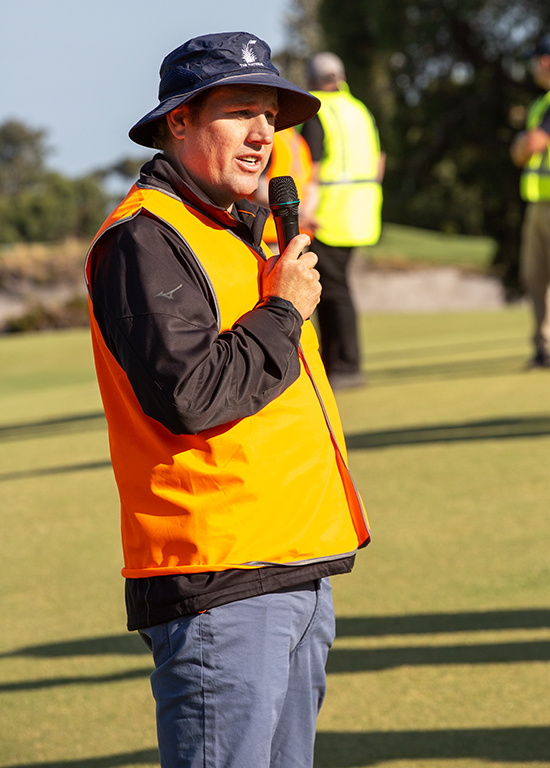 constructing a new 2.3km pipeline which will deliver treated water to four sites in Frankston North, including the Long Island course as well as local football, cricket and soccer grounds. The pipeline will come in directly behind the club’s 4th tee in the northeast corner of the property, with a pipeline running across to a series of storage tanks at the southern end of the course. The recycled water will be used to irrigate all the Santa Ana couchgrass surfaces (tees, fairways and surrounds) with Yanner hopeful that the pipeline will be online by September.
“Without that recycled water OCM’s design would have been pulled back quite dramatically because we simply wouldn’t have had enough water,” explains Yanner. “By getting access to that recycled water, The National is now in a fortunate position where we have effectively drought-proofed all our courses. At the Cape Schanck site we have two supplies of recycled water and a very good bore water license – and good quality bore water.
“At Long Island it was completely different. We investigated numerous options and worked with consultants and the number one thing they said we needed to do was get access to that recycled water. The scheme had been in the pipeline for a number of years and now that it is finally happening it will be a real game-changer for us.”
Yanner highlighted that the club has received great support from every consultant and contractor they have used throughout the project. Investing the time and resources into the planning stages of the project has been a critical element to ensuring its overall success, with Yanner looking forward to seeing the finished product and the unique offering it will provide to The National’s members.
“Of all our four courses at The National, Long Island has always been the busiest course, doing over 40,000 rounds a year,” explains Yanner. “The members have been great with the works and disruption going on here. But I think what OCM Golf are creating will be well worth the wait and something very different which we are all very excited about it.
“I can’t thank Simon (Page) and his team enough for the marvellous job they have done and everyone who has been involved in the construction. They’ve worked extraordinarily hard. They started out as sprinters and now they’re more marathon runners. Every hot period they’ve come in and helped out on weekends and never complained. They have been exceptional and we could not have asked for more from them.”